How is the BLEACH Mirrors High story different from the anime?
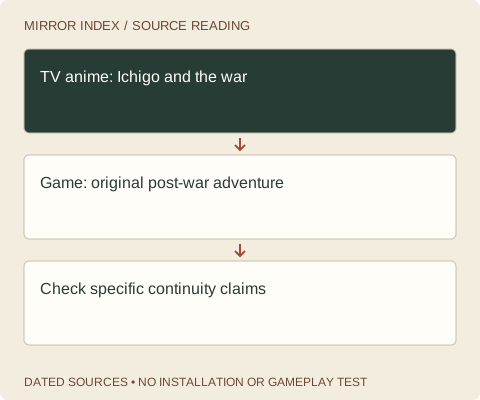
The comparison starts with the work you are choosing. BLEACH: Thousand-Year Blood War is the television anime’s final-arc project. BLEACH Mirrors High is a smartphone game whose publisher describes an original adventure after that war. They share BLEACH characters and imagery, but the game is not an episode-by-episode replacement for the anime.
The official Aniplex introduction follows Ichigo back into battle. The game introduction begins with a soul awakening in Karakura Town and offers a customizable Soul Reaper. That change in viewpoint matters: you are deciding whether to follow Ichigo’s televised conflict or enter an interactive story through your own avatar. This guide compares the published premises; it is not a chapter walkthrough or an account of our playthrough.
What does the post-war setting tell you?
The anime introduction describes the conflict with Yhwach’s Wandenreich. The game’s Story section places its original adventure after the Thousand-Year Blood War. Read those as different story contexts, rather than treating the game’s real-world launch date as a date inside the fiction.
The post-war label gives a useful starting point without resolving every chronology question. It does not supply a numbered month or an order alongside every novel. If you are comparing it with Can’t Fear Your Own World, look for a source that actually addresses that relationship. The broad setting alone cannot answer it. Readers avoiding post-war context should also know that even a premise comparison contains that setting information.
What does Kubo’s participation establish?
Kubo’s official game message says he “worked on the title, scenario, and character designs”. It also describes participation from the kickoff and work on the logo, auditions and recording. His statement about a connection to the comics provides more specific evidence than saying he merely approved artwork.
Keep the credits attached to the work they describe. The anime’s official staff list credits Kubo for the original work and general supervision; his game message describes the contributions above. Neither list is a sole-writing credit for every scene. They support creative participation without making all narrative-continuity questions interchangeable.
How should you read canon discussions?
The cited sources establish the original game premise, post-war setting and Kubo’s involvement. They do not settle a blanket main-continuity label. A reader deciding whether to try the adventure already has a concrete premise; someone using a game event to prove a claim about the manga needs evidence for that specific relationship.
For example, a source saying the story connects partly to the comics is not a complete chronology for every promotional scene. Keep the supported connection and the unresolved claim separate. That avoids presenting either “everything is binding” or “nothing counts” as an official conclusion when the cited material says neither.
Who are the new faces in the promotional material?
The original design feature identifies Shirin Migishima and Shirane Sanari. The later 15-character cast announcement supplies a wider set of official names and performers. These are better identity references than community nicknames or guesses based on a resemblance to an existing character.
Keep identity separate from availability and combat role. A design reveal or cast credit is not proof that a character is summonable, ranked, or included in a particular tool. Our character archive states its own record coverage; this story page does not expand that collection or invent kits for the original cast.
Why does the game opening look like an anime?
It is an animated opening for a game. In its October 28 launch release, Bandai Namco credits PIERROT FILMS with producing that opening. The same release describes Mirrors High as a smartphone game and names its mobile stores. Those details let a viewer identify the product behind a familiar-looking promotional clip.
An animation credit answers who made the opening, not where its scenes fit in the plot. Seeing Gin or Ulquiorra in promotion does not by itself establish resurrection, a parallel world or a new television arc. Describe the scene you saw separately from your explanation of it; a verified story scene or statement is needed to settle that particular claim.
What should you play or watch next?
To watch the war story, continue through the anime’s official introduction and episode information. To explore the original game adventure, first check the official download routes and your storefront’s requirements. Desktop readers can use the PC platform comparison before choosing an installation path.
Once you have access to the game, the mechanic guides answer action, timer and team-condition questions. The editorial method explains how this site separates sourced facts, interpretation and actual testing. This story page remains a premise comparison, not a claim that we completed the game or verified every plot event.