Find the right database route
Choose a lookup area or search the eight routes by subject. The links open their named source; no game-account connection is required to use this finder.
8 lookup routes
Fan database
Rarity variants and character records ↗
BLEACH Mirrors High Database
Start with the exact named variant and star rarity. A record found in game data is not by itself proof that your account can summon it.
Independent reference
Character skills and launch-kit context ↗
NiaMeowDB
A second presentation of launch-character kits, action cards and upgrade goals. Read its stated version before comparing an individual number.
Fan-hosted scene record
Chapter 2 dialogue and branching choices ↗
gacha.gg
Use the chapter, map and scene locator to inspect a choice in context. A transcript is not a played result or a guarantee about every language.
Fan database
Player Level milestone source table ↗
BLEACH Mirrors High Database
The Profile resource contains account-level rewards. Keep these separate from character EXP, MC Grade and Bond rewards.
Fan database
Summons, events and data additions ↗
BLEACH Mirrors High Database
The maintainer describes linked game-content records and a notice archive. Match the date and client version; a data entry can precede availability.
Official publisher
Publisher announcements and official routes ↗
Bandai Namco
Check an availability or campaign claim against the publisher. The product site is the official reference, rather than a replacement for a detailed fan table.
Our bounded guide collection
Source-based character role explanations
Mirror Index
The existing 14-record tool collection links published kit explanations. Separate Gin and Shinji articles do not silently expand that tool dataset.
Our versioned reward lookup
Look up a Player Level reward
Mirror Index
The existing guide checks 175 Lv.2–176 entries from BMH v1.0.4-01 and explains which progression track you are reading. It is a dated source snapshot.
No matching route. Try a broader subject or clear the filters. This finder searches the links listed here, not another website’s live data.
How do you compare the same character across databases?
Write down the full character title, rarity and the field you are comparing before reading a number. Two records with the same familiar name can describe different star rarities or ability stages. Our rarity explanation separates the star label from Grade and Limit Break; our ability-stage guide separates initial and final descriptions.
A useful comparison changes one field at a time. Keep the named variant fixed, inspect its printed action category, then compare the same stage. If one page describes a final ability and another shows an initial description, the mismatch does not establish that either site has invented the character. It establishes a scope difference to resolve.
The Mirror Index character archive is a bounded kit-reading collection with 14 tool records. Separate Gin and Shinji articles have their own source reviews. That collection should not be mistaken for every currently available card, and finding an additional record elsewhere does not automatically place it in our planner.
Which database field answers your reward question?
Start with what increased: Player Level, a character’s EXP, MC Grade or Bond. These labels describe different progression tracks. A material source labelled Player Level is not an instruction to spend character EXP Crystals, and a Bond reward is not an account milestone.
For account milestones, the fan Profile table is the underlying source used by our versioned Player Level reward lookup. That guide checks 175 entries from Lv.2 to Lv.176 in BMH v1.0.4-01, with its limits visible. Use the exact level and item name rather than assuming that a similarly named Diploma belongs to the same track.
If a current client shows a different requirement, retain the client language, displayed item and version with the discrepancy. A dated table is useful evidence, but it is not a receipt that an item reached your account. For MC promotion, follow the MC Grade and Diploma guide instead of treating every level field as interchangeable.
How should you use a story database for quiz answers?
A scene locator is the strongest starting point when several tests share a similar name. The Chapter 2 record lists a classroom scene separately from the later aptitude questionnaire. Our Rukia quiz guide concerns knowledge questions; the squad-choice aptitude section concerns recommendations and a reported answer route.
Use a transcript to identify wording and context. Proving that a dialogue option exists is different from proving its hidden scoring rule. A community-reported result needs its own attribution, while a reward claim needs an actual result or inventory record. This distinction lets you follow a useful clue without turning a readable script into an invented universal answer key.
What should you do when two sources disagree?
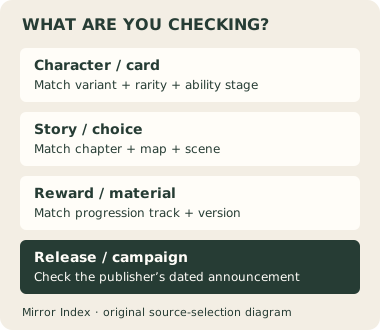
- Match the exact record: character title, rarity, level field or scene.
- Read the source date, version and client language. Keep older launch evidence labelled as older evidence.
- Check whether the claim concerns data presence, published availability or an observed gameplay result.
- For a release or campaign condition, follow the applicable publisher announcement; for a current result, retain what the game actually displays.
The database introduction explains the breadth of its records, while the story update explains a later feature addition.
Reviewed November 11, 2026. The source descriptions are an editorial comparison, not a timed uptime monitor, a mirrored data feed or a claim of publisher affiliation. Our methodology explains fact, inference and playtest labels. Send a specific versioned correction through Contact; never send account credentials.