Can a 3★ become a 4★ in BLEACH Mirrors High?
In the October 31 EX Color discussion, Any_Hippo1109 asked about 3★ → 4★. SwissJovizz and Kannaaaaaaaaaaaa described separate versions; these are player explanations.
The database separates 3★ Aizen, record 1029013 from 4★ Aizen, record 1029014. Match the stars as well as Standing at the Top.
If your goal is the 4★ copy, inspect its acquisition information and the current summon details. If your goal is improving the character you already own, inspect that copy’s enhancement options. Those are different decisions; the gacha guide handles summon and medal claims.
Why can different rarities use the same animation?
Aromatic-Special485’s October 31 question arose after seeing a story opponent perform familiar Aizen animations. In that thread, spooky_over_heaven thought stats were the only difference, while The_Relx suggested roster and Arena rotation value. The first is a mechanics claim; the second is an explanation of possible usefulness. Neither establishes the developer’s reason for the system.
The checked 4★ record includes a third Spirit Ability, Draw Point Bonus Obtained (First Entry): +100 on entry. The 3★ listing has two. That documented difference makes animation an unreliable test of kit identity; it is not an overall damage comparison.
Compare what an ability does, who receives its effect and when it triggers. A similar-looking attack can coexist with a different passive package. The Standing at the Top Aizen guide examines the published entry-buff and team-switch trade-off; it should not be read as a measured ranking of every Aizen rarity.
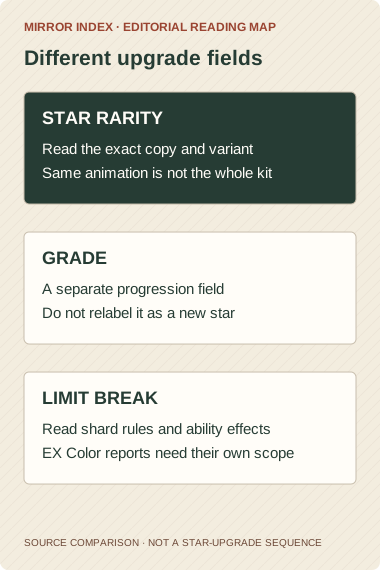
How do Grade, Limit Break and ability stage differ?
The database’s unofficial Help transcription, checked November 1, describes Grade Promotion as raising a level cap and Limit Break as shard-based enhancement of Innate Ability. Its EX Color entry describes a recoloring unlock for 4★ after seven Limit Breaks. These are separate tracks, not a star-conversion instruction.
Use that distinction to interpret a result screen. A higher level cap answers how far a copy can be leveled; an unlocked effect answers what that copy can do. A star label identifies the rarity entry being discussed. Write each field separately before comparing two accounts or following an upgrade recommendation.
The publisher’s initial and final Aizen descriptions provide another useful distinction: two states of the named Innate Ability appear under one introduction. They are not presented as a 3★ versus 4★ comparison. For the actual effect wording, use the ability-stage guide. For the protagonist’s dedicated promotion items, use MC Upgrade.
What does the blue-haired Aizen report establish?
SwissJovizz’s October 31 post describes a 4★ Aizen recolor and an exchange used for that account.
Keep three questions apart: which copy the author used, which enhancement state unlocked the appearance, and how they obtained the required resources. A reported purchase or lucky draw sequence does not establish a universal number of pulls or a cost in money. We therefore do not turn that account’s total into an EX Color price guide.
An appearance reward also does not show how a character performs at the same level and investment as another rarity. If the recolor is your goal, confirm the current requirement and resource balance shown for your exact copy before spending. If battle performance is the goal, compare its relevant effects first.
Why do players keep lower-rarity copies?
In OctoDADDY069’s October 28 discussion, BBSChamp argued that extra copies of different rarities help rotate Arena teams; BlazikenBlog pointed to shared Bond progression. These are practical explanations offered by players, not evidence that every low-rarity investment is efficient.
The useful question is what job the copy would do for your account. A rotation option, access to a favorite character and a main progression investment are different goals. Decide which one you are pursuing before reading “useful” as “best damage.” The mode guide supplies Arena context; it does not establish a tested rarity tier list.
Neither the game’s long-term release plan nor a guaranteed future replacement follows from those launch discussions. Keep the exact character identity beside any advice, especially when an image or a comment uses only the name “Aizen.”
How should you compare a gold 3★ with a fresh 4★?
Le_Faveau’s November 1 question captures the problem: an already developed roster is being compared with a higher-rarity alternative. asterr259 favored a stronger starting roster but also criticized Aizen’s combo behavior. That is an account recommendation and a combat opinion, not a controlled comparison proving one copy always wins.
- Identify both entries. Record name, variant and star rarity, then note grade, level and Limit Break separately.
- Read active effects. Check the ability currently unlocked instead of assuming the final description is already available.
- Name the obstacle. A required trigger, survival problem and missing damage window call for different changes.
- Compare the next investment. Consider what the resources would change now, rather than treating a star or grade as a complete recommendation.
Use the reroll framework for whether to keep a starting account. This page explains the rarity question; it does not tell you to discard a developed save. The source method separates publisher descriptions, database transcriptions, player claims and our interpretation. No gameplay benchmark, spending outcome or universal upgrade cost is claimed.