How do medals and pity differ in BLEACH Mirrors High gacha?
A random summon, a guaranteed slot, an exchange and an increasing draw probability answer different questions. “I reached pity” may mean a player bought shards with accumulated medals, rather than that the next random result became certain. Ask which mechanism the speaker means before comparing two accounts.
The publisher’s September 28 closed-beta response is useful historical context: a participant complained about the apparent absence of pity, while the development response pointed to medals and the Exchange Shop. It does not publish a launch-wide numerical guarantee. Both the complaint and the reply matter; quoting only the complaint creates a misleading account of that source.
In the October 31 EXCOLOR thread, SwissJovizz describes a final copy obtained through pity alongside other pulls. That explains how the term appears in actual player discussion. It does not tell us that another rarity, ticket pool or future event requires the same number of copies or draws.
What does the reported 200-medal exchange mean?
Game8’s guide, updated October 30 at 19:35, describes one medal per draw and a 200-medal exchange for 100 shards of a chosen character. It also warns that the medal type differs between gachas. These are that Japanese guide team’s observations, not our playtesting or a publisher guarantee for every region.
The useful distinction is the object being exchanged. Check whether the listed reward is a character, a quantity of shards, a ticket or something else; do not silently replace the displayed item with the outcome you hope to receive. Then confirm that it belongs to the exact variant you want. A matching face or familiar name alone is insufficient.
This page does not turn the report into a cash price or a promise that an account can reach the exchange for free. The available tickets, purchased and earned currency, regional offers and your existing balance are separate inputs. Read those in the current client rather than relying on a made-up monthly income estimate.
Why should you keep the pool and medal name together?
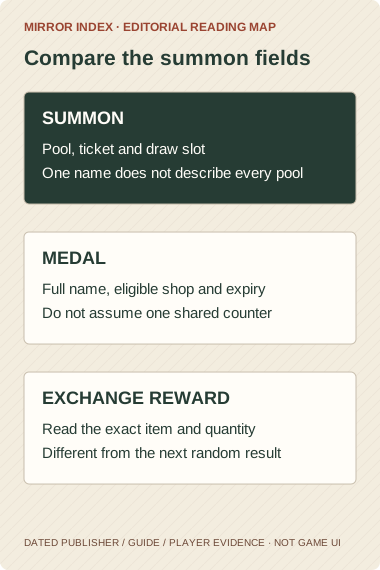
Read the named currency rather than inferring it from a button’s position. Ordinary and ticket buttons do not automatically establish separate currencies; compare their reward labels before assuming shared or separate progress.
Before committing resources, read the full summon name, any ticket suffix, the medal rewarded and the exchange’s eligible items. Compare the end of the summon with the end of the exchange: different dates can describe different parts of an event. Preserve the timezone shown by the source. A database’s internal availability timestamp is not a replacement for the game’s release date.
If a player says “pity does not carry”, ask whether they mean medals cannot be used in a different shop, an exchange closes, or a probability counter resets. These are distinct claims. Without the matching event rules, neither a blanket “always carries” nor “nothing ever carries” is justified. The absence of a shared label is a reason to inspect the rules, not a guessed diagnosis of a lost account reward.
How should you read a summon-rate table?
The fan database’s Mirrors Summon page labels its normal rarity total separately from each character’s chance and distinguishes the special tenth draw. Its normal table lists 3% for the 4★ category and about 0.23% for an individual listed character. Those figures describe that specific unofficial record; they are not advertised here as the rate of a limited Aizen summon.
When two screenshots disagree, compare the pool, slot, rarity, exact character variant and date first. A boosted target rate and an overall rarity rate can both be correct while describing different fields. A single multi-summon result is not enough to estimate the underlying probability. This guide therefore provides no simulated draw button or invented guarantee chart.
For decisions about star variants and upgrades, use the rarity comparison. For a character’s published ability conditions, read its specific kit entry. Neither a rarity percentage nor a shared animation establishes an identical kit.
Which information should you keep before asking about a result?
- The exact summon and ticket name, plus the date and region.
- The named medal and the exchange item you expected.
- Whether the claim concerns a random result, a guaranteed slot or an exchange.
- The relevant notice and the expiry/timezone displayed by the current client.
Those details make a player report comparable without requiring account credentials or payment information. This website does not connect to the game, spend Gems or redeem anything. Public posts should describe the rule at issue rather than disclose login details.
Already deciding whether to keep a starting roster? The reroll guide owns that separate decision. The provisional tier list compares published kits, not value per paid draw. A free download with optional purchases is not a statement that every desirable roster is freely obtainable.
For a purchase or subscription issue, use the current storefront terms and official support. The US App Store listing describes automatic renewal and cancellation separately from deleting the application. Regional prices and service terms should not be collapsed into one worldwide cost. Our methodology explains the distinction between publisher facts, attributed reports and editorial interpretation.