How do Mirrors High Chain Attack entry and Standby differ?
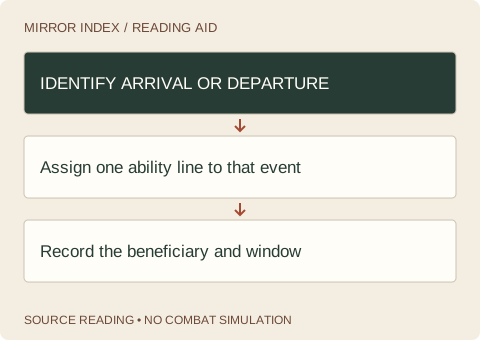
For Mirrors High Chain Attack, the useful starting question is whether the character is arriving or leaving. A description of entry and a description of returning to Standby can mention the same mechanic while referring to different moments. Write the character's name and the event together. “A Chain Attack happened” is too broad to assign every nearby ability to it.
This page uses Rukia and Rangiku as published examples of event reading. It does not teach an unverified button sequence, promise an uninterrupted combo or rank a team. Their individual Rukia and Rangiku pages own the complete kit assessments. Here, the decision is which line belongs to which event.
Make an entry ledger and a Standby ledger
Use two short headings in a note. Under entry, record the exact condition and beneficiary for the arriving character's relevant line. Under Standby, record the condition attached to leaving the field. If an effect mentions either of two routes to Standby, retain both routes rather than narrowing the effect to the one you hoped to use.
Keep ability sections separate as well. An archetype description, a Spirit line and Characteristics can each attach a benefit to a particular event. A familiar character name does not make these sections interchangeable. Copy the section label into your note so a later reader can trace the interpretation back to the correct place in the introduction.
The Draw Point Bonus guide owns the numeric resource-event comparison. Use it when the question is how to read a printed resource bonus. This page deliberately keeps the resource amounts out of its event ledger: the task here is assigning entry and exit conditions correctly before doing any resource planning.
A team benefit still needs the right trigger
A team-wide beneficiary does not remove the event requirement. First establish the event, then identify the effect, then record who benefits. Also retain the specific stat category. Critical Rate and Critical Damage answer different questions; a description that changes one should not silently become a promise about the other.
Stage matters when the published line changes between initial and final descriptions. Match the active text on your own copy before expecting an additional category. For a side-by-side explanation of stage labels, open ability stages. Do not interpolate missing levels or infer an unlock cost from the two printed endpoints.
Timing deserves its own field. Record the stated window using its published unit and note the event you believe starts it. Repeated activation does not establish a stacking rule, a refresh rule or permanent uptime. Those questions need their own evidence. A complete event ledger may therefore contain a supported trigger and an unresolved interaction.
Three notes that should lead to different checks
Fictional reading example, not a battle result: a reader records the covered character arriving through the named event, then points to that character's entry line. This is a coherent condition description. The next step is observing the stated beneficiary and effect; the written match alone does not prove activation.
A second reader records the character leaving, but cites an entry-only line. The note is aimed at the wrong side of the exchange. Move the observation to the Standby ledger and look for a line that actually names that event. If none is verified for the variant, leave the effect unassigned rather than borrowing another character's condition.
A third reader records an ordinary switch to Standby. Whether that meets a condition depends on the exact line. Rangiku's cited Characteristics explicitly make the alternative route relevant, whereas a Chain-entry condition remains an entry condition. This is why “same character, same exchange” does not settle the interpretation.
Export a reading plan, then collect an observation
The inspector asks about the event, ability section and beneficiary. Its output is a reading plan based on your answers. Optional notes can hold a version, mode, exact variant, active stage and what you actually observed. Leaving the notes blank is valid; the tool will not supply a fictional result to complete the record.
Use Switch cooldown if your remaining question is a timer, and Cover Change for the outgoing-ally exception. Vanishing Evasion addresses a different successful event. Return to all guides when the next unresolved question changes rather than stretching this page into a general combat manual.