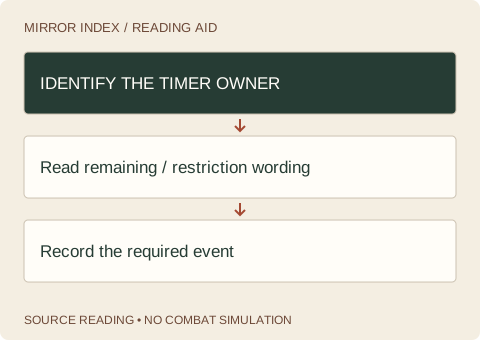
Whose timer does a Mirrors High Switch cooldown line affect?
A Mirrors High Switch cooldown question is incomplete until it names the actor. Are you watching the character who left, another teammate, or the opponent? Write that actor beside the visible ability line before planning a rotation. An observation about a different actor can be accurate while failing to answer the question the ability raises.
The official examples above deliberately preserve their different wording. They are not inputs to a universal calculator. An entry penalty, a reduction after a successful event and a restriction on the opponent have different triggers and scopes. This page helps you classify the line you are reading; the Aizen guide owns his complete kit and offensive tradeoff.
Keep “remaining” attached to the timer
When a description explicitly names a remaining timer, retain that word in your note. It directs your observation toward a timer that is already relevant at the named event. A shorter line that simply lists a cooldown reduction should not acquire additional timing or team-wide scope because another ability happens to use those terms.
This distinction is useful even without a confirmed base timer. You can ask which timer existed immediately before an event, which actor it belonged to and what appeared afterward. You do not need to invent a default value to identify a missing subject. Leave base cooldowns, floors and stacking rules unresolved unless current instructions or controlled observations establish them.
Preserve the unit exactly as shown. A printed Count window is not permission to replace Counts with seconds. Nor does a numerical reduction establish how several effects combine. If two lines are relevant, record them separately and identify the order you observed instead of presenting a summed total as a verified rotation.
Do not merge restrictions with cooldown changes
A restriction answers whether an action is available under a stated condition. A cooldown line answers a timer question. Seeing that a switch cannot be performed does not, by itself, identify which explanation applies. Check the current status and event before attributing every unavailable action to a long timer.
The Cover Change guide covers a third distinction: a conditional exception concerning the outgoing ally. Prevention of a new cooldown should not be rewritten as removal of every existing timer. Keeping that exception on its own page also prevents a general timer explanation from turning into an unsupported controls tutorial.
A useful comparison records a sequence
Illustrative planning example, not a playtest: a reader wants to know why a teammate is unavailable after an entry. First they identify the entrant and stage. Next they record the teammate's timer before entry. Finally they note the event and the same teammate's display afterward. If the original record contains only the last display, the direction of change remains uncertain.
For a second question, the reader wants to inspect a reduction after an evasive event. They must first establish that the required success event occurred. An attempted action and a successful action are different evidence. The Vanishing Evasion guide owns that event distinction; this page owns the timer's subject and wording.
Record version, mode, exact variant, active stage and other timer effects before comparing two notes. Change one relevant condition at a time where possible. If the current description differs from a dated introduction, keep both texts with their dates and send the discrepancy through Contact & Corrections. Do not label a mismatch a bug before resolving identity and scope.
Turn an unclear timer into a next check
The inspector asks for wording, actor and trigger. Its review does not calculate a cooldown or decide whether your team can execute a combo. It produces a short checklist of what your selected description supports and what you still need to observe. Add your own notes only if you have them, then download a portable copy before leaving.
If your unresolved question concerns entry versus Standby, use Chain Attack conditions. If it concerns resource gain, use Draw Point Bonus. For an attack category rather than a timer, use Physical versus Spiritual damage. Keeping one question in each record makes the next action more precise.