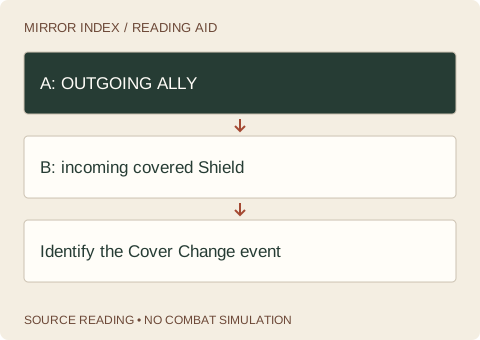
Who benefits from Mirrors High Cover Change?
The useful question is who leaves and who arrives. The official Sado introduction describes a conditional exception involving two actors. It does not describe a universal reset button. Write the active character as A and the incoming character as B before interpreting the effect. Those labels keep a sentence about A from turning into a promise about B.
The compact source table above contains the published rule. The inspector on this page helps you check whether a situation matches it. It classifies your description; it cannot detect a battle, confirm an animation or establish that an effect activated. An honest “not confirmed” answer gives you a better next observation than a confident answer based on the wrong actor.
Cover Change and field entry answer different questions
For Mirrors High Cover Change, an entry alone does not prove that the particular event named by an ability occurred. Read the condition attached to the effect you want to explain. If a note says only “B entered”, it is incomplete evidence for the required event. Add the actual event label from the game or leave the entry method unresolved.
Sado is a useful example because his published kit contains separate self and team effects. Keep each in its own note rather than treating an observed increase as evidence that every nearby line activated. For his full kit and HP-dependent entry wording, use the Sado character guide. That page owns the character-level assessment; this page owns the Cover Change condition and its actors.
Also separate prevention from removal. A statement that a new timer does not start is not evidence that an older timer disappears, that every teammate becomes available, or that a restriction on the opponent ends. Use the Switch cooldown wording guide when the unresolved question is which kind of timer a line changes.
Three descriptions that lead to different conclusions
Illustrative decision, not a measured battle: A reader records A leaving, B entering, B matching the covered Shield kit and the event being identified as Cover Change. That is a description which matches the source condition. The next useful check concerns A. Watching an unrelated teammate's timer would not answer the stated question.
In a second fictional note, the same characters exchange places, but the reader only records an ordinary switch. The characters alone do not complete the condition. Keep the event unresolved or identify a different event; do not upgrade an ordinary-entry note into a Cover Change record because the desired result would be convenient.
In a third note, the event is identified but the reader watches the incoming character. The observation may still be useful, yet it is aimed at a different actor. Relabel the screenshot or worksheet before drawing a conclusion. A source can be accurate and an observation can be real while the comparison between them still asks the wrong question.
Build a record that can explain a mismatch
Before checking a result, record the exact variant, visible ability description, incoming character, outgoing character and identified entry event. Record an existing timer separately from any timer that would begin after the exchange. Include the game version and mode so a later correction has a usable context. These are suggested observation fields, not claims that this guide has performed the battle.
Then describe one result in plain language. “I watched B” is more actionable than “Cover Change is broken” because it reveals which assumption needs checking. If the event name is uncertain, retain that uncertainty. If the ability line differs from the dated introduction, preserve the current wording and use the correction channel to report the discrepancy with its context.
Change one question at a time. First resolve identity, then the event, then the beneficiary. Repeatedly changing the team, entry method and observation target together makes it difficult to identify why two records disagree. This is a way to organize evidence, not a recommended combat rotation or a promise about the most effective team.
Use the inspector for the next decision
The three questions on this page deliberately follow that order. Choose the description you can support, review the interpretations and export the worksheet if you want a portable note. A completed worksheet is your classification of a situation, not a live game result. Reopen an answer when a screenshot or current ability description changes the evidence.
For a different defensive event, use the Vanishing Evasion condition guide. For entry-versus-exit language, use the Chain Attack guide. The Draw Point Bonus lookup owns resource events, while Physical versus Spiritual damage owns action categories. Those are separate questions; a Cover Change record should not become a claim about resource totals or damage formulas.