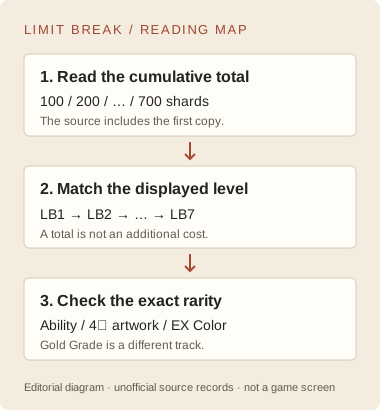
How does a BLEACH Mirrors High Limit Break count the first copy?
The 4★ Ichigo material table starts at LB1 with a total of 100 Shards. Its accompanying note equates one copy from a summon or exchange with that amount. At LB2, the table says 200 in total. Reading that as another 200 after acquiring the character would count the first portion twice.
Keep three quantities on separate lines: the displayed Limit Break level, the cumulative requirement in your reference, and the Shards actually held by your account. The same number can mean something different when a screen shows a total rather than the amount still missing. The table above follows the source’s total column; it does not inspect your inventory.
This is also why “two copies” and “two more copies” should not be used interchangeably. The table’s example can be explained without predicting a number of pulls: acquiring a particular copy is not guaranteed on every summon. Shards from another named route may also contribute. Use the gacha guide for banner and exchange distinctions, not the milestone total as a summon guarantee.
Which abilities, alternate art and EX Color can a Limit Break unlock?
The comparison keeps the same character identity across two rarities. Both linked records have seven Innate levels, but their Spirit Ability coverage differs: the 3★ entry stops at two Spirit Abilities, while the 4★ entry lists a third at LB6. The 4★ alternate-art milestone appears at LB2. That is a concrete difference between these entries, not a damage ranking of every rarity.
The fan-transcribed help separately describes Mirror Holographic artwork for a 4★ at LB2 and EX Color at LB7. The latter changes parts of the character’s coloring and has a toggle in the described character-detail or pre-battle view. An illustration change and a color toggle answer different requests; neither means that a Gold 3★ has become a 4★.
Read the two November 5 player questions and their limits
ValuableArtist5430 asked whether one character copy was enough. Replies discussed artwork, Spirit Abilities and whether further duplicates were worthwhile. Those are attributed player judgments, not proof that every account can clear the same content with the same roster.
Shaff_98 wanted Orihime’s alternate illustration and initially thought Gold was required. In the reply chain, dylan1011 distinguished Limit Break from Grade; the questioner then identified the Gold lock as Action Card enhancement. This is a useful example of two similar-looking upgrade goals being mixed together.
A named character page may publish initial and final ability wording without explaining every resource step. The publisher’s Ichigo introduction is such a kit source, with its development qualification. The milestone table here comes from the separately labelled fan records; the publisher introduction is not being cited as confirmation of their Shard costs.
Which Shards count, and why does the exact rarity matter?
The 4★ reference lists its character-specific Shard, a matching red 4★ Resonance Shard and a 4★ Universal Shard as contributing materials. The 3★ entry names the corresponding 3★ versions. “Universal” therefore should not erase the star label when you compare an item with a requirement. Match the full item description in your client before assuming it can substitute.
Compare the source’s cumulative total with your actual inventory separately. Material eligibility does not establish a shop’s current stock, price or reset schedule; no recurring exchange schedule is assumed here.
The help says obtained Character Shards can advance Limit Break automatically. A player may therefore see a changed level after an acquisition rather than a separate identical promotion button. If your result differs, preserve the exact rarity, Shard name, old level and new level before concluding that an item failed. We did not obtain a duplicate or spend a Universal Shard to test this behavior.
Is Gold Grade, star rarity or Bond the same upgrade?
No. Grade raises a character’s level cap; the source links Gold to Action Card enhancement. Limit Break instead develops the copy through its Shard track. Star rarity identifies which version you own, and Bond is another progression track with its own points and rewards. Switching between those labels can make a completed milestone look like an unmet requirement.
Our rarity comparison retains the broader 3★ versus 4★ question. The Martial Teachings guide covers the Action Card effects available after Gold. For account-level Diploma rewards or a capped protagonist, use MC upgrades; for unapplied relationship points, use Bond Charge. A higher value on one track does not complete another by itself.
Do you need a second copy, and where should you stop?
Start with the specific outcome you want. If it is an alternate illustration, check the exact character’s art milestone. If it is a missing Spirit Ability, inspect that ability’s stage and condition. A general desire for a larger displayed number does not identify which reward would solve the current problem.
Comments in the duplicate thread express different stopping preferences, including pursuing art while avoiding the cost of a fully developed copy. Treat those as opinions with an account context. They do not establish that a second copy is mandatory for all story stages, that a seven-copy target is good value for everyone, or that a successful summon is due after a fixed number of attempts.
- Identify the copy: character, variant and star rarity.
- Name one milestone: an ability, artwork or color option.
- Read totals correctly: compare the displayed level, cumulative reference and actual materials separately.
- Compare the next benefit: read its condition before valuing it for your team.
- Set a resource boundary: an available route is not a requirement to keep summoning.
This free reference does not connect to a game account, grant Shards or calculate a guaranteed pull budget. It preserves the dated source distinctions so you can evaluate a particular milestone. Reviewed November 6, 2026; report a conflicting current label through our corrections contact with the exact version and record. Our editorial method distinguishes public-source interpretation from gameplay testing.