Which BLEACH Mirrors High Martial Teachings family should you compare?
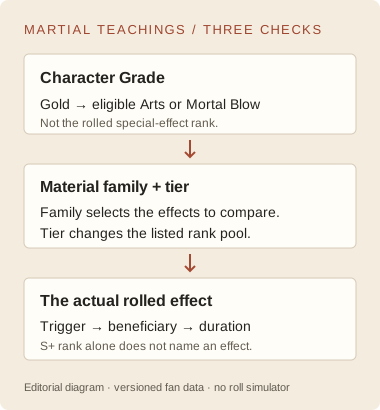
The material name has two jobs. Attack, Defense, Action, Spirit or Bond identifies a family; an unprefixed item or an Advanced, Superior or Exemplary prefix identifies the material’s quality tier. The first helps you find an appropriate kind of effect, while the second changes the listed rank pool. A higher tier of an unrelated family does not answer which effect fits an action.
- Attack
The catalog includes direct Arts damage, critical-hit and conditional offensive effects. Compare an unconditional entry with one requiring a particular enemy or attribute situation.
- Defense
Its entries include defense changes and resistance-related effects with their own triggers. Read which event starts the benefit instead of treating possession of the material as permanent protection.
- Action
This family includes effects involving ailments, debuffs and application chances. Existing enemy conditions and a chance to apply a new condition are different requirements.
- Spirit
Draw Point effects appear here. A reward on an ordinary hit, on a down, or against a named archetype should not be counted as the same repeatable gain.
- Bond
The family name labels an enhancement pool with conditional personal or team benefits. It does not make the item a way to increase the separate character Bond Level.
These are reading categories drawn from the versioned enhancement catalog, not a five-family strength ranking. The useful comparison is the action you intend to enhance, the effect’s recipient, and how often the stated condition is actually met. A maximum printed value without its trigger can favor the wrong choice.
Why is an S+ rank rate different from one named effect’s chance?
The opening comparison describes the rank distribution. The catalog explains that a family contains eight effects and that its higher-quality materials restrict ranks. Its Exemplary Attack row shows S at 20% and S+ at 80%. That does not say one particular Attack effect has an 80% chance to appear at S+.
The older NiaMeowDB effect table, explicitly dated October 29 and version 1.0.2, illustrates the distinction: individual Exemplary Attack entries at the highest value are listed at 10%, including the named critical-hit and conditional offense effects. Those are effect-and-value outcomes rather than all outcomes sharing the S+ label. The older table is a cross-check with its own date, not proof that every current rate remains unchanged.
Compare a material, rank, named effect and trigger
- Material: Exemplary is the tier, while Attack is the family.
- Rank: S+ is an outcome class in the reference table.
- Effect: Mastery of Offense is a particular entry, not a synonym for S+.
- Trigger: its wording names three hits with that action before its temporary critical benefit.
The catalog’s broad rank figure and the older table’s named-outcome figure should not be interchanged. No drop sample, independent roll test or guaranteed stopping budget is supplied by this guide.
Do not turn a reference rate into a promise that the desired result must arrive within a fixed number of materials. A page showing a probability does not establish protection against repeated unwanted outcomes, a carry-over rule or a guarantee. Check the exact current enhancement information before valuing a scarce material.
How should you read a Martial Teachings effect’s trigger?
Read the action, qualifying event, beneficiary and duration in that order. A phrase attached to “this Action” does not automatically affect the whole team. A temporary benefit after a qualifying sequence is different from an always-active stat, and a downing condition cannot be substituted with any ordinary hit.
In a comment under Aaroniero’s video, @izumiken1716 questioned the difference between three hits and three uses for Mastery of Offense, particularly on a single-hit action. That is an attributed question. It is a reason to preserve the source’s hit wording, not evidence that this guide has measured which frames or uses increment the counter.
The same first-page sample includes @wombatio reporting an S+ Offense result on Aizen. The report establishes what that player said, without giving a reproducible comparison, success rate or complete loadout. We do not promote it into a universal recommendation for every Aizen action.
For resource effects, the Draw Point Bonus guide explains why an on-hit award and a downing award need different event checks. For ailments, use status effects. For an action’s own attack category and timer, use Mortal Blow. Enhancing that action does not make those separate fields interchangeable.
Why is enhancement locked before Gold Grade?
The fan help’s Grade section names Gold as the unlock for Action Card enhancement. The character catalog repeats that gate above its enhancement tables. Gold here belongs to the character’s Grade, while D through S+ describe a rolled effect’s rank. They are two different scales.
A character with a high Limit Break level can therefore still need a separate Grade check. Conversely, reaching Gold is not a promise of a particular random enhancement or a new star rarity. The Limit Break comparison owns duplicate-Shard milestones; rarity versus Grade explains the version labels.
The help identifies Arts and Mortal Blow cards as enhancement targets. It does not say every yellow Skill or passive slot can be treated in the same way. If your problem is finding or equipping an inherited option, return to MC skills. A missing reward and an enhancement gate should be diagnosed separately.
What should you compare before using a higher-tier material?
- Confirm eligibility: match the character’s Grade and the intended action.
- Identify both parts of the item: family and quality tier, not just the most impressive word.
- Read the possible result: keep the effect’s name, rank and value together.
- Check its condition: distinguish hit, down, enemy state and the beneficiary.
- Read the current confirmation: verify what your client says will change before spending materials.
The reviewed help says Martial Teachings come from rewards in various game modes. That broad statement is not a verified fastest-farming route, current shop-stock schedule or entitlement to a particular item. A material source must be checked against the edition and event you can actually access; the linked catalog can help identify the full item name.
This page is a free reference with no game sign-in or account connection. The diagrams and comparisons explain source fields; they do not roll, save or apply enhancements. Reviewed November 6, 2026. BMH records retain their v1.0.4-01 label, the NiaMeowDB comparison retains its older v1.0.2 date, and player comments remain reports. Send a current source correction through Contact; our methodology describes these evidence limits.