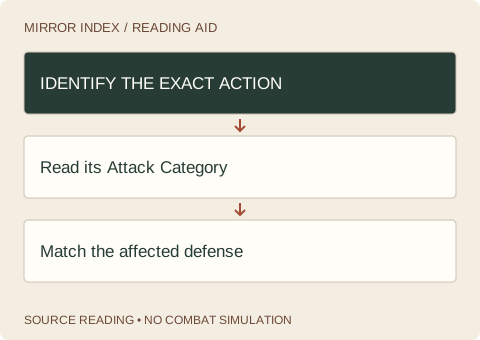
Which field defines Mirrors High Physical vs Spiritual Damage?
Read Attack Category on the particular Action Card you intend to use. Do not replace it with the character’s overall style, archetype or your impression of the animation. A description can contain several useful labels, but those labels answer different questions. Keeping them in separate fields is the first step toward a team note that another person can actually check.
The examples above come from official October 23 introductions checked October 31, 2026. Their development disclaimer remains relevant. These are published fields rather than independent tests of the current damage formula. Match the exact variant and current action text before treating an old preview as a statement about your own copy.
Separate the action name, Arts type and Attack Category
The action name identifies which button or record you are reading. Arts type supplies another classification. Attack Category is the field this page compares. A character-level label is broader still. Writing all of those labels into one column makes it too easy to transfer a property from one action to another without evidence.
The sourced contrasts are useful precisely because a familiar-looking action does not settle the category. The Ichigo guide and Toshiro guide retain the exact character records; this page instead owns the cross-kit category-reading task. It does not assign either character a new rank or infer a damage multiplier from their labels.
Choose the follow-up before judging a modifier
Start with the action you want a teammate’s effect to improve. Identify its category, then copy the modifier’s wording separately. If the modifier names a qualified defense stat, retain that qualification. Do not silently rewrite it as a universal damage increase. A numerical value can be accurate while the conclusion about who benefits is unsupported.
Mayuri’s published Skill provides the concrete example in the fact table. The wording gives a reason to inspect Physical follow-ups. It does not, by itself, establish an equal benefit for Spiritual actions or a complete formula for the resulting damage. Keeping that boundary visible is more useful than producing a precise-looking calculation from missing rules.
Setup failure and category uncertainty are different problems
Imagine a plan that needs a target condition before a modifier is available. First check whether the condition appeared. If it did not, changing the follow-up category does not explain the missing setup. If it did appear, inspect the next action’s category and timing. These are successive questions, not interchangeable reasons for a disappointing attempt.
The status-effects guide owns the application, subject and beneficiary check. Here the question is narrower: does the written category support the way you are describing the follow-up? Avoid turning a generic Defense label into a separately verified Physical Defense or Spiritual Defense rule. Preserve the source wording until a current source explains the relationship.
What does a dash on a Special Skill tell you?
A dash is not permission to invent a hidden damage category. Keep the effect’s own description beside the field. When you are reading a buff or another non-damaging effect, record what it changes rather than pretending it is an extra damaging hit. This also prevents an analysis from adding an unverified attack to a proposed sequence.
The same discipline applies to mechanics described elsewhere. A Cover Change or Vanishing Evasion event should not be substituted for an Attack Category. If your question concerns when the next character can enter, read Switch cooldown; if it concerns an entry condition, read Chain Attack. None of those terms supplies a complete damage model.
How should you compare two category-related ideas?
Write the same narrow objective for both: for example, checking whether the source labels support a proposed follow-up. Keep variant, active ability stage, target and other teammates together. Record which action was actually used and whether the relevant condition was active. Leave damage and outcome fields blank until you have observations rather than filling them with a hypothetical benchmark.
When several settings change, label the result as a broader comparison. Do not attribute the entire difference to category alone. Likewise, an Attack percentage is not enough to reconstruct the game’s full calculation: defensive stats, effect resolution and other rules would need verified inputs. This reader deliberately supplies no universal Physical-versus-Spiritual multiplier or resistance chart.
Use the character comparison for its original covered roster, ability stages for a stage mismatch, and the methodology for evidence boundaries. The useful result is a correctly framed category check, not a claim that one damage category is always better.